
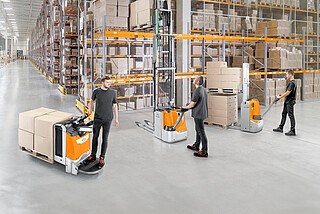
Pallet truck checklist: How to find the right warehouse truck
In day-to-day warehouse operations, choosing the wrong vehicle can be costly, both at the time of purchase and every day it is in use. Asking the right questions before buying will help you find a vehicle that truly suits your needs.
Choosing the right warehouse truck is one of those decisions that can have a lasting impact on day-to-day warehouse operations, for better or worse. If the decision is well-informed and carefully considered, operations will run more efficiently, safely and cost-effectively. However, if it is made too hastily, the drawbacks will be felt not just once, but every single day.
Many companies find themselves at precisely this juncture: Which warehouse truck truly meets my requirements? The answer depends on far more than just load capacity and price. It comes down to the specific conditions in your own warehouse: aisle widths and heights, shift patterns and battery technology, ergonomics and total cost of ownership. Five questions can help clarify the situation and identify what really matters in each case.
Not quite sure what you’re looking for yet? No problem! Here, you can quickly and easily find out which truck best fits your needs.
Do you simply need to move your loads, or do you also need to store them at a certain height?
This question, which at first glance seems quite simple, sets the course for everything that follows. After all, it determines whether you will need low lift pallet trucks, double stackers or high lift pallet trucks in your warehouse.
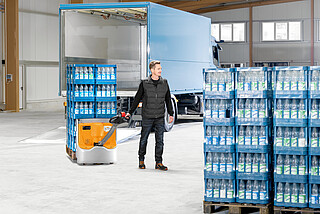
Low lift pallet trucks are specifically designed for horizontal transport. They only lift the load high enough to safely move it, so they are not suitable for storing goods on shelves. They are ideal for moving pallets at floor level. A fitting low lift pallet truck is also the right choice for transporting a truck in a lorry. This type of truck offers compact, robust models that fit easily into a lorry while providing enough manoeuvrability to navigate the load area.
High lift pallet trucks, on the other hand, are designed not only for horizontal transport but also for vertical movement: they load and unload pallets onto and from racks, lifting them to considerable heights. Anyone who not only transports goods but also stores them should definitely consider a high lift pallet truck.
A double stacker is the ideal solution for transporting fragile or non-stackable goods. When it comes to non-stackable goods in particular, productivity can be significantly impacted by whether one or two pallets can be transported per load.
In addition to the basic function, two further factors come into play: the required load capacity and the type of pallet used. When it comes to load capacity, the rule of thumb is to always allow for a safety margin. For example, if you need to move 900 kg, it is better to choose a truck with a capacity of 1,200 kg. An important point to note with high lift pallet trucks is that the load capacity decreases as the lift height increases, so it is essential to check the so-called residual load capacity. The type of load carrier used, whether Euro pallets, industrial pallets or others, also influences the choice of forks for the pallet truck.
What are the physical space conditions at your premises?
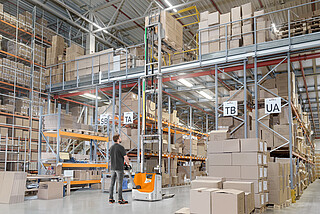
Even the best forklift truck is of little use if it cannot manoeuvre around your warehouse. This is why it is essential to analyse the available space in detail before making a purchase decision. For high lift pallet trucks, the key factor is the lift height. Different mast types are used depending on the dimensions of the racking: simplex mast, duplex or free view mast for lower lift heights, and triplex mast for greater heights. As a general rule, always add 200 mm to the height of the topmost shelf to ensure safe storage.
The routes and the distances to be covered within the warehouse also determine the choice of vehicle. For short distances, a pedestrian-operated vehicle is sufficient; the operator walks alongside it. However, this can become tiring over medium distances. In such cases, a vehicle with a foldable stand-on platform, which the operator can ride on, is recommended. For long distances, the stand-on platform should be permanently fitted to ensure lasting comfort and high efficiency throughout the entire shift.
In addition to lift height and travel distance, the width of the aisles should also be checked before selecting a truck. This will determine the possible dimensions of the truck, particularly in the case of 90° bends where the external dimensions of the truck and its turning radius are crucial. Anyone using high lift pallet trucks must also consider clearance heights. Although the mast of a high lift pallet truck can be retracted, this is limited – the truck must still fit under gates, mezzanines, and other ceiling structures.
Finally, the condition of the routes must be considered: where ramps or inclines need to be negotiated, the truck’s gradient capability must be checked.
How intensive is the work?
The intensity of use is a key factor in determining which vehicle class and battery technology are best suited to the usage scenario:
A truck designed for occasional use is not suitable for multi-shift operations. Instead, solutions should be chosen that are specifically designed for use in demanding environments and can easily handle long shifts and heavy loads. In addition, customisable configuration options and state-of-the-art driver assistance systems ensure the highest level of precision and safety in operation.
Similarly, businesses with moderate requirements for internal transport do not need to invest in a truck that is designed for 24/7 operation in highly demanding environments and is therefore oversized for their own needs.
In such cases, compact, standardised, readily available trucks that focus on the essential core functions are generally the right choice.
When it comes to battery technology, there are essentially two options:
- Lead-acid batteries are inexpensive to purchase but require a long charging time of six to eight hours, as well as maintenance and special requirements for the charging area.
- Lithium-ion batteries, on the other hand, can be charged more quickly, are maintenance-free, and have a long service life. Although the initial costs are higher, this type of battery offers many advantages. Lithium-ion technology is up to 30% more energy efficient than lead-acid batteries. This protects the environment and significantly reduces a company’s energy costs.
Find out more about the lithium-ion technology now.
Charging infrastructure is a frequently overlooked issue. It should be factored into the planning process from the outset, as additional requirements regarding the charging area, ventilation and safety may arise depending on the size of the fleet, the type of battery and the charging capacity. Anyone operating multiple trucks should also consider implementing a smart charge management to avoid peak loads and to ensure availability, flexibility and transparent cost control.
How many hours a day do your drivers spend operating the equipment – and what physical stresses are they exposed to?
Anyone who works with an industrial truck for hours every day soon realises that good ergonomics are crucial for productivity and health. This applies to all types of vehicle, be it a low lift or high lift pallet truck.
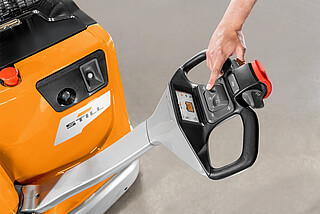
For pedestrian-operated trucks, an ergonomically designed tiller head is essential – it should be comfortable for both left- and right-handed people to operate. Having a standardised operating concept across different vehicle types also makes it easier to switch between machines and reduces training times. Operators of vehicles with a platform benefit if the platform is spring-mounted and adjustable to their body weight, as this reduces whole-body vibrations. Proportional lift control enables precise, fatigue-free operation. For higher load capacities, electronic steering is recommended.
When it comes to safety features, it is worth taking a closer look at the individual models. Depending on the vehicle type and equipment variant, various functions are available, ranging from automatic braking systems and lift height limitations to visual warning systems. Generally speaking, the more demanding the application, the greater the importance of safety features when choosing a vehicle.
How much should it cost – to buy and over its entire service life?
The purchase price accounts for only part of the total cost. Anyone who bases their decision on warehouse trucks solely on the purchase price will quickly lose sight of the actual expenditure. The Total Cost of Ownership (TCO) is the decisive factor. This includes maintenance, wear parts and downtime.
Another often-overlooked factor is the requirement for a driving licence. In Germany, for example, according to the German Social Accident Insurance provisions (DGUV Regulation 68), industrial trucks (e.g. forklifts) with a driver’s seat or platform may only be operated by trained personnel. Furthermore, under the German Road Traffic Licensing Regulations (StVZO), a driving licence is required for vehicles used on public roads travelling at speeds exceeding 6 km/h. Therefore, training costs and the time required for driver training must be factored in from the outset.
Find out everything you need to know about the forklift operator certification requirement here.
The right choice is the one that best fits your warehouse
Structured answers to the five questions provide a solid foundation for choosing the right truck. This clarifies how loads need to be moved and what conditions apply in the warehouse. The intensity of use and the drivers’ day-to-day needs are also taken into account. Last but not least are the costs, which are considered not just at the time of purchase, but over the entire service life.
After all, choosing the right pallet truck is a long-term decision. It should still be suitable even if operational requirements change. So please feel free to contact our experts for personalised advice on selecting the right truck. We’re here to help!
Contact a STILL consultant now!
STILL is constantly developing its portfolio of warehouse technology to provide businesses with even better support in their day-to-day operations, from selecting the right equipment to offering cost-effective solutions. Find out more and gain valuable insights here.
Contact us
Subscribe to the Newsletter !
Always up to date with STILL: Subscribe to the STILL newsletter and we will inform you regularly about interesting industry topics.
