
Orchestrator of the automated warehouse: The warehouse control system
When people think of automation, they tend to think of driverless transport systems, conveyor technology and shuttles first. However, the long-term success of an automation solution often hinges on another key component: the warehouse control system.
In an orchestra, every instrument is important. However, each musician plays from their own score, and it is only when someone assumes the role of orchestrator — setting the tempo, giving cues and coordinating the orchestra as a whole — that a harmonious sound is achieved. The same principle applies in an automated warehouse. Instead of instruments and musicians, various systems and goods flows must work together, and the orchestrator is a piece of software: the warehouse control system (WCS). The WCS controls and organises all the components involved, from mobile robots to sorting systems. The WCS coordinates the interaction between stationary and mobile systems to ensure smooth operations.

The intralogistics software pyramid
In fact, the WCS is just one of the systems that keep a complex automated warehouse running smoothly. It provides the foundation on which other software solutions can be built. To illustrate this, we can refer to the intralogistics software pyramid. At the top is the enterprise resource planning system (ERP), which maps out how the entire company operates. Below that is the warehouse management system (WMS), which organises stock storage and management. The next level is the warehouse execution system (WES), which calculates and prioritises transport sequences. Finally, at the base, the WCS operates. The WCS decides which system carries out the transport. To do this, it breaks down transport orders into logical steps and assigns them to the relevant execution system. The fleet controller or the programmable logic controller (PLC) then sends specific commands to the hardware.
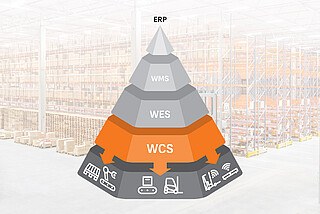
In practice, however, these levels often overlap. Some providers, for instance, combine WES and WCS. Therefore, what matters is not the terminology, but what the software can actually do. What specific tasks does it perform? How deeply does it integrate with individual devices? And how do the different levels exchange data with one another?
Would you like to find out more about the different layers of the software pyramid? Our white paper about how WCS operates in warehouses provides a comprehensive explanation. Click here to read the full text.
What does a WCS do in the warehouse?
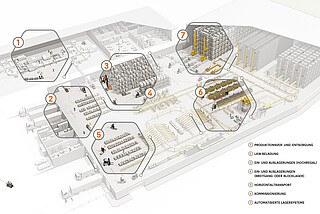
Anyone who has ever looked behind the scenes of a modern warehouse, whether partially or fully automated, will have an idea of just how much is happening there all at once. Sensors, scanners, barcodes, RFID tags and cameras are constantly recording thousands of data points, which the system then has to evaluate in a matter of milliseconds. To put this into perspective: a single shuttle system transmits its location and status several hundred times for every transport order. Automated guided vehicles (AGV) constantly report their location. Conveyor systems continuously relay information about their speed, occupancy and operational status. Neither a WMS nor an ERP system is designed to collect these volumes of data in real time, consolidate them, and assign them to individual devices. This is precisely the function of the WCS.
When do you need a WCS?
Not every automated warehouse immediately requires its own WCS. As a general rule, a dedicated WCS becomes essential as soon as more than two different types of equipment need to operate in sync. This is because a higher-level system is required to act as an intermediary between the WMS and the equipment. The greater the number of goods flows to coordinate, the more technologies to integrate and the higher the required throughput and transparency, the more the software must deliver.
However, even on a small scale, it is not possible to do without software entirely. AGVs and autonomous mobile robots (AMR) require logic to tell them how to move safely and efficiently through the warehouse. In its simplest form, this is a traffic control system or fleet control system — an elementary version of a WCS that is sufficient for individual fleets. As soon as vehicles from different manufacturers need to work together, a more sophisticated solution is required. If all vehicles have a standardised interface, such as VDA 5050, a master fleet controller (MFC) can be used instead. This controls mixed fleets via the standardised interface. This is a decisive advantage for companies that do not wish to be tied to a single supplier. However, an MFC does not replace a WCS – it only takes on a specific part of its function: cross-manufacturer vehicle coordination. As soon as stationary technology, such as conveyor systems or shuttles, also needs to be coordinated, a WCS is still required to act as the higher-level control layer.
Although many companies start out with a small fleet when implementing automation, it makes sense to choose a WCS that can be scaled up as the business grows. These companies may well wish to add further conveyor systems, or even integrate a shuttle system, in the future. Taking this into account from the outset can save time and money in the long term.
Integrated rather than pieced together
A wide range of WCS solutions are available on the market — from specialised, standalone systems designed for specific types of equipment, to comprehensive solutions that span several levels of the software pyramid. Specialised standalone solutions have their place, particularly when the use case is clearly limited. However, as a warehouse becomes more complex, the advantages of an integrated solution, such as STILL’s iGo flow connection software, become more evident. This software package combines WMS, WES and WCS. This offers many advantages:
- Fewer interfaces – and therefore fewer points where data can be lost or transmitted incorrectly.
- Everything in a single database – making it easier to identify and resolve issues more quickly.
- Less effort required to implement, customise and maintain the system – as there is no need to coordinate multiple systems.
iGo flow is also a modular system. This means that STILL customers can start by purchasing only the module they need. This could be a WMS or a WCS. Similarly, interface modules for other automated systems or forklift guidance systems for manual forklift trucks can be purchased and implemented individually. If further systems are then required, they can simply be retrofitted. The advantages are lower initial investment and modules that fit together perfectly, even if they are not implemented all at once.
How do you find out which solution is right for your business?
Successful automation requires collaboration: both within your own company and with external partners. That is why STILL supports its customers throughout the entire implementation of automation solutions.
The first step in this process is typically a thorough analysis of the customer’s requirements. STILL's modular iGo solution can be tailored to suit warehouses of all sizes and levels of automation, and can be expanded and adapted at any time.
Invest early, secure long-term success
The WCS is much more than just a technical detail on the fringes of an automation project. It orchestrates the interaction between hardware, software and people. Those who recognise its importance early on, plan flexibly and scalably, and seek out a partner who can support them at every level of the software pyramid lay the foundations for a project that works today – and can grow with them tomorrow. Ultimately, even the best hardware is of little use if no one is setting the pace.
Contact us
Subscribe to the Newsletter !
Always up to date with STILL: Subscribe to the STILL newsletter and we will inform you regularly about interesting industry topics.
